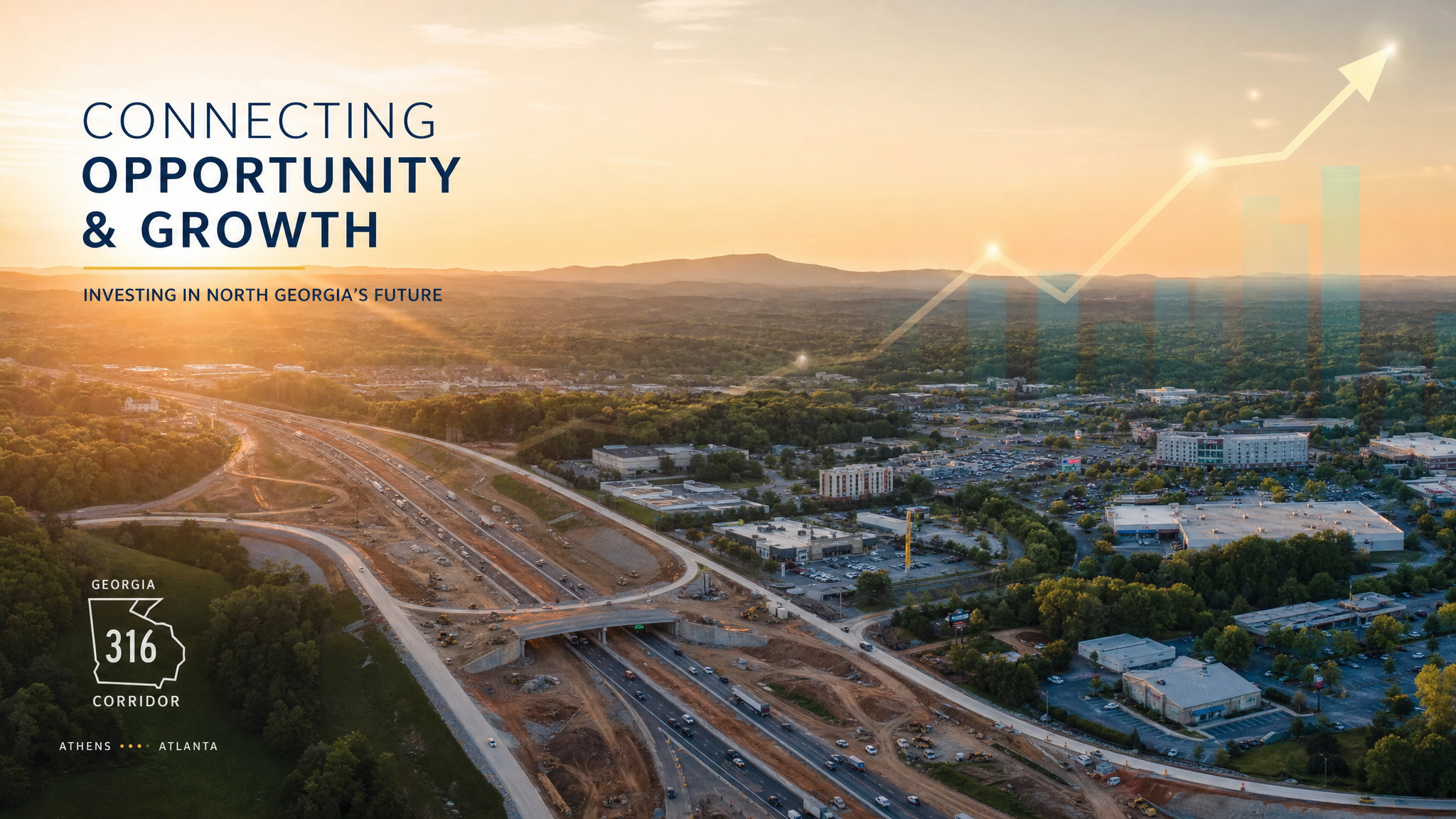
The state of Georgia made a significant commitment to one of its most strategically important corridors in January 2026, announcing an additional $200 million in funding for improvements along Highway 316 — the 50-mile spine connecting the Atlanta metropolitan area to Athens and the University of Georgia. For business owners, investors, and anyone tracking commercial real estate along this stretch, the announcement isn't just a transportation story. It's an economic signal worth watching closely.
A Corridor That Was Already Moving
The funding announcement builds on GDOT's ongoing "Transforming SR 316" program, a comprehensive planning and construction initiative aimed at modernizing the highway from its interchange with I-85 in Gwinnett County all the way to SR 10 near Athens and Oconee County. Work along the corridor has been visible for years — but the fresh capital injection suggests the state views this investment as far from finished.
The additional $200 million layers on top of work already underway, accelerating improvements that include interchange upgrades, added travel lanes in congested sections, and safety enhancements designed to reduce the stop-and-go friction that has long been a complaint of daily commuters and commercial drivers alike.
What the Money Means Along the Route
The communities positioned along the corridor — Lawrenceville and Dacula in Gwinnett County, Bethlehem and Winder in Barrow County, and the Oconee County communities approaching Athens — have each been watching the corridor's transformation with a mix of anticipation and pragmatism.
In Dacula and the Harbins Road area, development interest has been building steadily. The Rowen project — a massive mixed-use employment campus spanning Gwinnett and Barrow Counties — has drawn national attention precisely because of its proximity to a maturing Highway 316 corridor. When a $2+ billion development of that scale plants its flag along a highway, the gravitational effect on surrounding land values and business activity is real.
Further east, Winder and Barrow County have seen increasing attention from light industrial, distribution, and service-sector businesses looking for affordable land with credible connectivity back into the Atlanta metro. That formula only improves as the highway itself improves.
Near the Athens end of the corridor, Oconee County has continued to attract commercial and retail investment that draws from both the university community and the growing suburban population pushing east out of Gwinnett. Improved highway access tightens the commute window and expands the realistic customer and employee draw for businesses located there.
Reading the Investment Signal
Infrastructure capital at this scale doesn't appear in a vacuum. When the state allocates $200 million to a specific corridor, it's often responding to — and reinforcing — development pressure that's already building. The Highway 316 corridor has, for years, functioned as a secondary route for those priced out of I-85 and I-285. As land costs in core Gwinnett locations have risen, that corridor has become an increasingly attractive alternative for businesses that need proximity to Atlanta without paying Atlanta-adjacent prices.
The new funding accelerates that dynamic. Easier access, better interchanges, and a more reliable travel time between Athens and Lawrenceville make every business along the route a little more viable — and every parcel of commercial land a little more attractive to a buyer who might have been on the fence.
The Opportunity Ahead
For business owners considering a sale, acquisition, or expansion in the coming 24 to 36 months, corridor infrastructure investment is one of the cleaner indicators of where buyer demand is likely to consolidate. Communities that sit at active interchange points — Dacula, Bethlehem, Winder, and the I-85 gateway in Gwinnett — tend to attract attention first, with secondary ripple effects spreading along the corridor as confidence builds.
Practical takeaway
- Georgia's $200M additional investment in SR 316 accelerates a multi-year transformation of the corridor from I-85 in Gwinnett to SR 10 near Athens.
- Communities at interchange points — Dacula, Bethlehem, Winder, and the I-85 gateway — tend to attract buyer attention first, with ripple effects spreading east.
- For business owners along the corridor, confirmed infrastructure investment is one of the cleaner signals that buyer demand is consolidating in your market.
First Choice Business Brokers Atlanta Metro works with business buyers and sellers across the Highway 316 corridor, including Gwinnett, Barrow, and Oconee Counties. If you're evaluating a sale or looking for acquisition opportunities in this high-growth region, reach out for a confidential conversation.