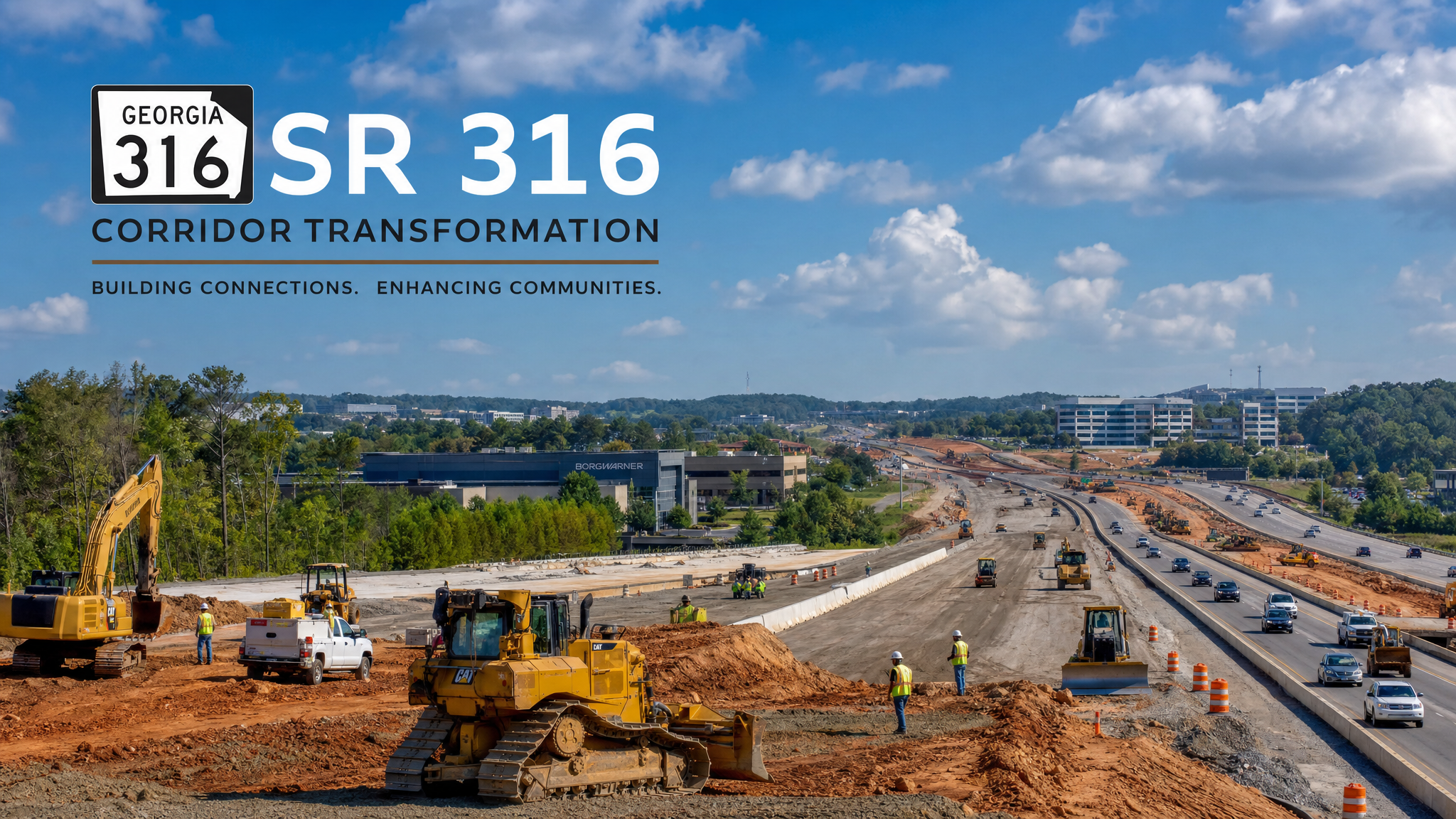
Drive Highway 316 today and the evidence of transformation is hard to miss. Crane booms rise above interchange ramps near Dacula. Orange construction barrels narrow lanes through Bethlehem. Work zones that have been fixtures for years are slowly giving way to finished pavement, expanded lanes, and modernized intersections. What began as a regional transportation planning effort has turned into one of Georgia's most consequential infrastructure buildouts — and its impact on the business communities along the corridor is only beginning to be felt.
The "Transforming SR 316" Vision
GDOT's "Transforming SR 316" program didn't emerge from a single project approval. It reflects a longer-range planning commitment to one of the state's most congested and economically underserved corridors. The highway, which stretches from I-85 in Gwinnett County to SR 10 near Athens and Oconee County, carries a diverse mix of traffic — UGA students and staff, commercial trucking, daily commuters, and an increasing stream of business traffic generated by the distribution centers, manufacturing facilities, and service businesses that have settled along its length.
The planning study underlying the program identified bottlenecks, interchange deficiencies, and capacity shortfalls that have long suppressed the corridor's potential. Investment flowing from that work is now showing up in the physical fabric of communities from Lawrenceville to Winder to the edge of Athens.
Community by Community
In Gwinnett County, the Dacula and Harbins Road area has emerged as one of the most closely watched development zones in the region. The Rowen mixed-use employment campus — a multi-decade project designed to attract research, technology, and innovation employers — sits squarely in the corridor's gravitational field. Its developers have been explicit: connectivity to I-85 and to Athens via Highway 316 is central to the site's value proposition. As the highway improves, so does the case for Rowen and the supporting commercial ecosystem that tends to grow around large employment anchors.
To the east, Bethlehem and Barrow County represent the middle stretch of the corridor — historically more rural, increasingly on the radar of logistics and light industrial operators looking for land that's affordable but not isolated. The highway improvements that thread through this section matter enormously for those use cases. A fulfillment center or regional service operation can only work if trucks can reliably reach it, and the ongoing upgrade work on SR 316 is closing the gap between Barrow's land economics and its logistical credibility.
In Winder, the county seat of Barrow County, local development officials have been deliberate about positioning the town as a landing zone for businesses relocating from more expensive parts of the Atlanta market. Improved corridor access is a central part of that pitch.
Further east, Oconee County and the Athens metro have their own stake in the outcome. For years, the practical friction of the 316 drive — particularly through the more congested Gwinnett sections — created a psychological barrier between Athens-based businesses and Atlanta-area markets. As the highway improves, that barrier erodes. Businesses in Athens and Oconee County gain more credible access to Gwinnett suppliers, customers, and talent. Conversely, Atlanta-area buyers and investors begin to view Oconee County properties and businesses through a slightly different lens when the drive is more predictable.
Infrastructure as a Pricing Signal
For business buyers and sellers, corridor investment has historically preceded price appreciation in commercial real estate. The sequence is fairly predictable: infrastructure funding is announced, land values along active development nodes begin to move, and within 18 to 36 months the market reprices businesses and properties in the corridor to reflect the improved access reality.
The Highway 316 corridor is somewhere in the middle of that sequence right now. Construction is visible. Investment is confirmed. But many commercial assets along the corridor — particularly between Bethlehem and the Athens edge — are still priced closer to their historical baseline than to their emerging potential.
Practical takeaway
- GDOT's Transforming SR 316 program is a multi-year, multi-community investment — not a single project — and its effects are becoming visible across Gwinnett, Barrow, and Oconee Counties.
- Infrastructure investment historically precedes commercial real estate repricing by 18 to 36 months — the corridor is currently in that window.
- Many commercial assets between Bethlehem and Athens are still priced at historical baseline, ahead of the emerging corridor premium.
First Choice Business Brokers Atlanta Metro tracks business sale and acquisition activity across the entire SR 316 corridor. If you're a business owner or investor looking to understand how these changes may affect your position, contact us for a no-pressure consultation.