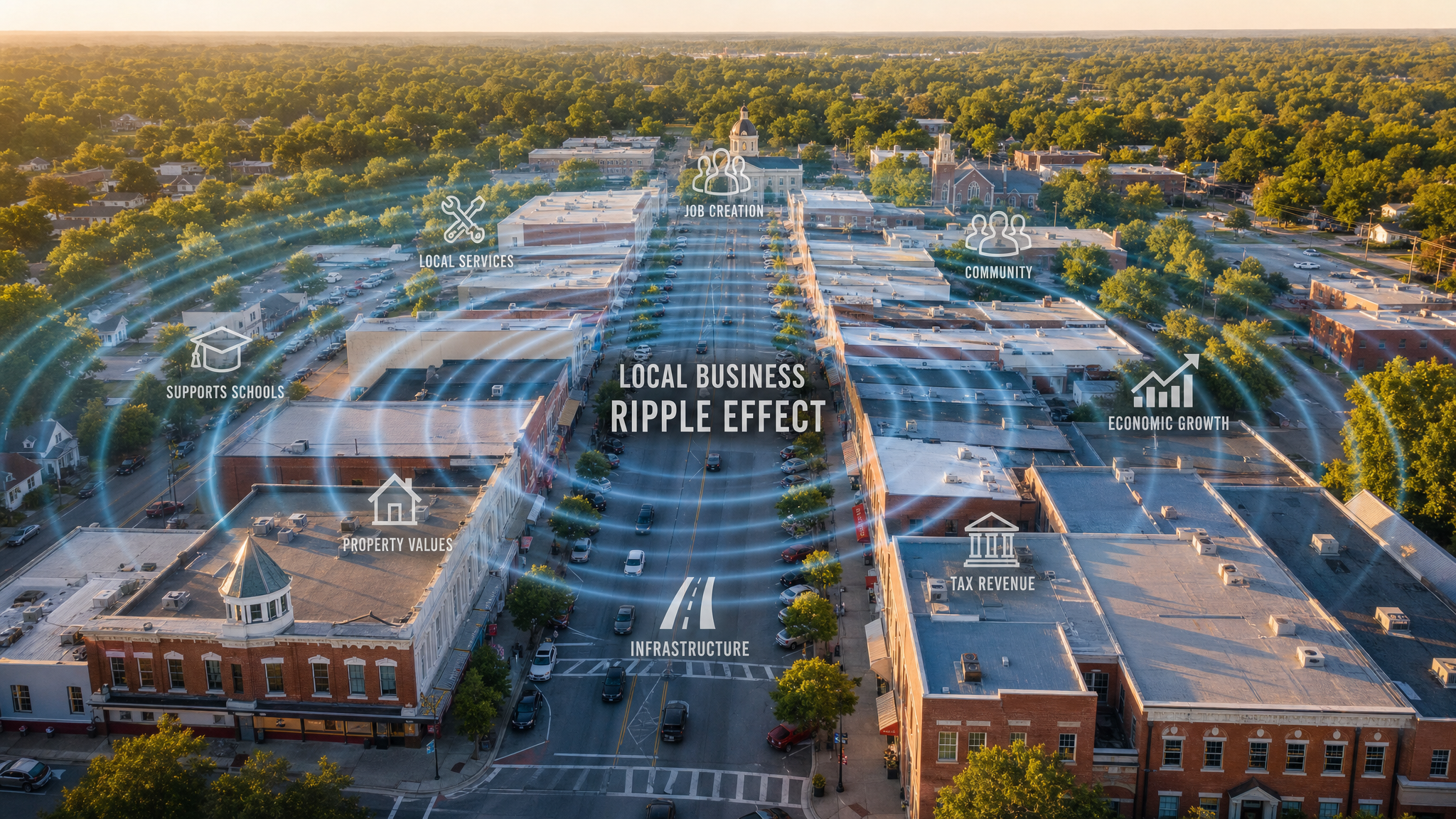
Imagine dropping a boulder into a still lake. The initial splash is massive — but the rings that spread outward reach every corner of the water.
That's the Savannah River Site in Georgia's economy.
The boulder: billions in annual federal spending flowing through a 310-square-mile DOE facility on the Georgia-South Carolina border near Augusta. The rings: thousands of jobs, contracts, homes, and businesses that extend far beyond the site's fence line — and far beyond the Augusta metro.
If you own a small or mid-size business in Georgia, those rings are reaching you. Here's what to look for.
Start With the Workforce
SRS directly employs tens of thousands of people — a mix of federal workers and contractors across disciplines ranging from nuclear engineering to environmental science, security, IT, logistics, and administrative roles. Most of these workers live in Georgia, primarily in Richmond and Columbia counties — Columbia County among Georgia's fastest-growing.
These aren't minimum-wage positions. SRS and its contractors are competing for technical and professional talent, which means the workforce in the Augusta metro has higher average incomes than many comparable-sized regions. High-income workers spend differently — and more consistently — than a region built on retail or hospitality employment.
For small business owners, that stable, well-compensated workforce is the foundation of a healthy local market.
The Contractor Ecosystem: Where Small Business Wins
The SRS operation doesn't run on federal employees alone. It runs on contractors — and contractors need subcontractors, suppliers, and service providers. That's where Georgia small businesses enter the picture.
Major prime contractors at SRS spend heavily on:
- IT services and cybersecurity — Managing a federal facility of this complexity requires robust technology infrastructure and continuous security monitoring
- Environmental and engineering consulting — Active decommissioning projects need specialized expertise, and not all of it lives inside the big prime contracts
- Facilities and maintenance — Keeping 310 square miles of infrastructure operational is a perpetual, large-scale facilities management challenge
- Transportation and logistics — Moving materials, equipment, and people across the site and the region requires a sophisticated logistics network
- Professional services — Legal, HR, financial, and compliance support for a workforce and operation of this size generates consistent demand
Small Georgia businesses that want a piece of this ecosystem don't necessarily need a direct federal contract. They need to be positioned as a reliable vendor or subcontractor to the companies that already hold those relationships.
Housing and Real Estate: The Demand You Can Count On
One of the most tangible ways SRS spending affects Georgia small businesses is through housing demand. Columbia County, Georgia — one of the primary residential communities for SRS workers — consistently ranks among the fastest-growing counties in the state.
That growth creates direct opportunity for:
- Residential real estate and property management
- Home services (HVAC, plumbing, landscaping, cleaning)
- Mortgage and financial services
- Retail and grocery
- Childcare, tutoring, and education services
This isn't speculative demand. It's driven by a workforce that shows up every day, gets paid, and lives in the community. In May 2026, the DOE awarded a $5 million workforce development grant to the SRS Community Reuse Organization — a sign that SRS employment will continue to grow and deepen for years to come.
Beyond Augusta: The Statewide Reach
Here's what many Georgia business owners outside the CSRA miss: the SRS effect doesn't stop at the county line.
When SRS contractors hire from Atlanta, Savannah, or elsewhere in Georgia, those workers often retain ties — and spending patterns — that connect back to their home communities. Supply chains that run through Augusta often source materials from Metro Atlanta distributors, middle Georgia manufacturers, and across the state. Growth in one major Georgia region lifts the economic conditions for the whole.
At the same time, SRNL's expansion into AI and advanced research is beginning to attract technology companies and high-skill workers to the region. In May 2026, energy and community leaders met at the Energy Communities Alliance Forum in Augusta to plan the region's next chapter — a chapter that includes new nuclear opportunities, research partnerships, and economic development that will draw companies and talent from across Georgia and beyond.
The Decommissioning Opportunity Nobody's Talking About
One underreported aspect of the SRS story: active decommissioning projects are opening up land for future economic development. As Cold War-era facilities are remediated and closed, that acreage becomes available for new purposes — industrial parks, research campuses, commercial development. The businesses that get in early, establish relationships, and build local presence will be positioned to capture the next wave of opportunity.
Is Your Business Positioned to Capture the Growth?
The ripple effect of SRS spending is real, measurable, and growing. The question for every Georgia business owner is simple: Are you in the right position to benefit from it?
Whether you're thinking about expanding your service area into the Augusta market, pursuing federal subcontracting opportunities, or simply understanding what the broader Georgia growth story means for the value of your business — the time to get clarity is now.
Practical takeaway
- The SRS contractor ecosystem creates subcontracting and vendor opportunities for Georgia small businesses across IT, engineering, facilities, and professional services.
- High-income SRS workers drive consistent housing, retail, and services demand in Columbia County and surrounding communities.
- Statewide supply chains and talent networks mean the SRS effect reaches businesses far beyond the Augusta metro.
Get a free business valuation from First Choice Business Brokers Atlanta Metro and find out what your business is worth in today's economy.
Schedule Your Free Valuation at atlantametrofcbb.com/valuations